
Why Is My House So Humid?
How to Control Indoor Humidity in West Virginia
Summer in West Virginia doesn't just bring high temperatures - it can bring high humidity too.
If your home feels sticky or damp even when the air conditioner is running, you may be dealing with more than just the heat. Excess indoor humidity can affect your comfort, indoor air quality, and even how hard your cooling system has to work.
At Dodrill Comfort & Energy Solutions, we help homeowners throughout the Charleston, WV area identify what's causing uncomfortable indoor conditions and find solutions for better whole-home comfort.
What Is a Good Indoor Humidity Level?
For many homes, an indoor relative humidity level of approximately 30% to 50% is generally considered comfortable, although the ideal level can vary depending on outdoor conditions and the home.
When humidity levels remain too high, your home may begin to feel warmer and less comfortable even when the thermostat shows a reasonable temperature.
That's because your body relies partly on evaporation to cool itself. When there's already a lot of moisture in the air, that process becomes less effective.
A 72-degree home with high humidity can feel much less comfortable than a 72-degree home with properly controlled humidity.
Signs Your Home May Have Too Much Humidity
High indoor humidity isn't always obvious. Some common signs include:
- A sticky or clammy feeling indoors
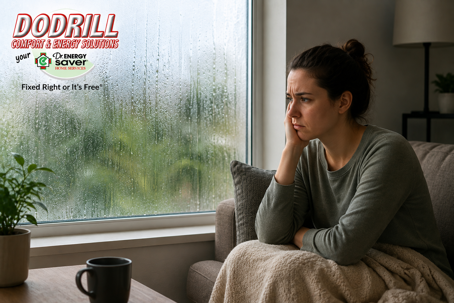
- Condensation on windows
- Musty or damp odors
- Rooms that feel uncomfortable despite the AC running
- Visible moisture in certain areas
- Mold or mildew growth
- Your air conditioner running frequently
- Difficulty maintaining consistent comfort throughout the home
- Damp-feeling basements or lower levels
If you're experiencing several of these issues, it's worth finding out what's causing the excess moisture rather than simply lowering your thermostat.
Why Is My House So Humid Even With the AC Running?
This is one of the most common questions homeowners have.
Your air conditioner does more than cool your home. It also removes moisture from the air as part of the cooling process.
However, several conditions can prevent an AC system from controlling humidity effectively.
1. Your Air Conditioner May Be Oversized
Bigger isn't always better when it comes to HVAC equipment.
An oversized air conditioner may cool your home very quickly and shut off before it has had enough time to remove sufficient moisture from the air. This is known as short cycling.
Your thermostat may reach the desired temperature, but the house can still feel sticky and uncomfortable.
That's one reason proper HVAC system sizing is so important when replacing heating and cooling equipment.
2. Your AC System May Not Be Operating Properly
A system that isn't performing correctly may struggle with both temperature and humidity.
Problems involving airflow, refrigerant, coils, drainage, or other components can affect performance.
If your home suddenly feels much more humid than usual, particularly when the AC previously kept it comfortable, an HVAC system inspection may help determine whether there's an underlying equipment issue.
3. Outside Humidity Is Getting Into Your Home
West Virginia homes can have air leaks that allow warm, humid outdoor air to enter.
In these situations, the HVAC system may be trying to remove moisture while additional humid air continually enters the home.
That's why humidity problems aren't always strictly an air conditioning problem. Sometimes you need to look at the whole house.
- Windows and doors
- Attics
- Crawl spaces
- Basements
- Ductwork
- Plumbing and electrical penetrations
- Other gaps in the home's building envelope
Can a Whole-Home Dehumidifier Help?
For homes that consistently struggle with excessive humidity, a whole-home dehumidifier may be an effective solution.
Unlike a portable dehumidifier that primarily treats one room or area, a whole-home system is designed to help manage moisture throughout the home's conditioned space.
However, installing a dehumidifier without determining why the home is humid isn't always the best first step. The underlying cause matters.
- Maintain more comfortable indoor humidity
- Reduce the sticky or clammy feeling associated with humid air
- Improve overall indoor comfort
- Reduce conditions that encourage mold and mildew growth
- Work alongside your heating and cooling system
- Provide more consistent humidity control throughout the home
Should I Turn My AC Down to Remove Humidity?
Lowering the thermostat may provide temporary relief, but it isn't necessarily the best solution.
You could end up making your home colder than you actually want while still failing to properly address the moisture problem. It can also mean longer cooling cycles and additional energy use.
If you're constantly lowering the thermostat because the house doesn't feel comfortable, humidity may be one of the things worth investigating.
Can High Humidity Increase My Energy Bills?
Potentially.
When humid air makes you feel warmer, you may compensate by lowering the thermostat. Your cooling system may then operate longer or more frequently to maintain that lower temperature.
But there can also be other reasons for high summer electric bills, so humidity shouldn't automatically be assumed to be the only cause.
A properly operating HVAC system combined with appropriate humidity control can help create a home that feels comfortable without relying solely on increasingly lower thermostat settings.
Why Some West Virginia Homes Have More Humidity Problems Than Others
Every home is different.
Age, construction, insulation, air sealing, ductwork, crawl spaces, basements, HVAC equipment, drainage, and even how the home is used can influence indoor humidity.
That's especially important in West Virginia, where homes can vary significantly in age, construction style, terrain, and foundation type.
Two homes on the same street can have completely different comfort problems. That's why we believe in diagnosing the home rather than guessing at the solution.
Do I Need HVAC Service, a Dehumidifier, or an Energy Audit?
It depends on what's causing the problem.
If your home suddenly became humid and your air conditioner isn't cooling properly, the first step may be HVAC service or repair.
If the cooling system is operating properly but the home consistently experiences excessive moisture, a whole-home dehumidifier may be worth considering.
If you're experiencing multiple comfort problems - such as high humidity, uneven temperatures, drafts, high energy bills, or rooms that are difficult to heat and cool - a whole-home energy audit may provide a more complete picture.
Rather than treating symptoms one at a time, evaluating the home as a system can help identify where comfort and efficiency problems are actually coming from.
Frequently Asked Questions About Indoor Humidity
Why does my house feel humid at 72 degrees?
Temperature and humidity both affect comfort. If the indoor relative humidity is high, a 72-degree home can still feel sticky or uncomfortable.
Does an air conditioner remove humidity?
Yes. Air conditioners remove some moisture from indoor air during normal operation. However, equipment problems, improper sizing, excessive moisture infiltration, or other conditions can prevent adequate humidity control.
Will a bigger AC reduce humidity better?
Not necessarily. An oversized system can actually contribute to humidity problems because it may satisfy the thermostat and shut off before running long enough to adequately remove moisture.
Is a whole-home dehumidifier better than a portable dehumidifier?
They serve different purposes. Portable units can be useful for individual rooms or localized moisture problems. A whole-home dehumidifier is designed to provide more comprehensive humidity management across the conditioned areas of a home.
What should I do if my house suddenly feels more humid?
If this is a new problem - especially if you've also noticed reduced cooling performance, unusual system operation, or longer run times - having your HVAC system inspected is a good place to start.
Get Help With High Humidity in Your West Virginia Home
If your home feels sticky, damp, or uncomfortable even with the air conditioning running, don't assume you just need to turn the thermostat down.
There may be an underlying HVAC, humidity, airflow, or home-performance issue contributing to the problem.
Dodrill Comfort & Energy Solutions helps homeowners throughout Charleston and surrounding West Virginia communities evaluate heating and cooling performance, indoor humidity, and whole-home comfort.
Whether the solution involves HVAC service, a whole-home dehumidifier, or a more comprehensive home energy evaluation, our goal is to identify what's actually causing the problem and recommend the appropriate solution.
Call Dodrill Comfort & Energy Solutions at (304) 776-8094 to schedule an appointment.
Fixed Right or It's Free®